

Original research
Google Maps SEO: how far does your ranking actually reach?
Google Maps SEO is not one ranking, it is a map. We ran 40 geogrids and 24,924 measurements across 10 UK towns to find out how far a ranking really travels.
You do not have a Google Maps ranking. You have a map, and it changes street by street.
On 25 August 2026 we ran 40 geogrids across 10 UK towns and 4 trades, 49 search points each, and measured how far away the searcher was from every business that appeared. That is 1,959 searches and 24,924 usable measurements.
Not one business in the study held the top three across even three quarters of its own town. The widest reach anybody managed was 6 points out of 49.
The short version
- Sample: 40 geogrids, 10 towns, 4 trades, 49 points each, 2 miles apart, covering 12 miles by 12. 10,324 businesses, 24,924 measurements, 25 August 2026.
- Under a mile away, a business appears in the top three 29.5 per cent of the time. Between 5 and 8 miles, 10.1 per cent.
- 1,312 businesses ranked first somewhere. The median one held the top three at 1 point out of 49.
- Median furthest top three: 1.42 miles. Median furthest first place: 0.90 miles.
- Reviews buy about a mile. Under 10 reviews reaches 0.71 miles, 150 or more reaches 1.84.
- Cost of the whole study: $3.92.
What one town actually looks like
This is a single 12 mile square around Paisley, one search, “electrician”, run from 49 points. Each square is one search and the number is which business came first.
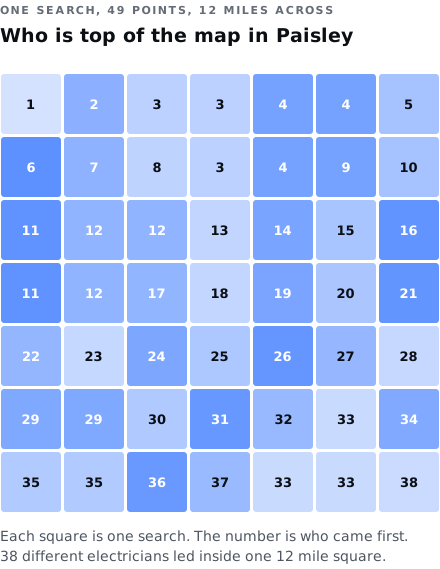
38 different electricians led inside one 12 mile square.
Thirty-eight different electricians were top of the map. Not thirty-eight in the results, thirty-eight in first place, inside an area you could drive across in twenty minutes.
Across all 40 grids the median was 36.5 different businesses leading in one town, the tightest was 22 and the loosest 47. In none of the 40 did a single firm lead throughout.
If somebody tells you they will get you to number one for your trade in your town, ask them which street corner they mean. On this evidence there is no such thing as being number one in a town. There are 49 different number ones, and there would be more if we had measured more points.
How fast it falls away
Every result carries its own coordinates, so we could measure the real distance from each business to each searcher rather than guessing from grid position.
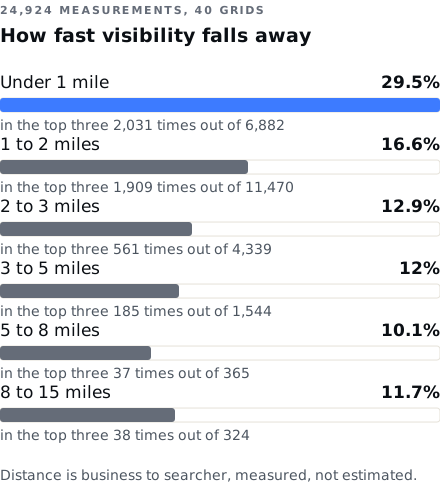
24,924 measurements across 40 grids.
| Distance to the searcher | In the top three |
|---|---|
| Under 1 mile | 29.5% |
| 1 to 2 miles | 16.6% |
| 2 to 3 miles | 12.9% |
| 3 to 5 miles | 12.0% |
| 5 to 8 miles | 10.1% |
Visibility roughly halves in the first mile. Median rank goes from 7 under a mile to 11 by five miles. The curve then flattens rather than going to zero, which is the tail of businesses that show up further out because there is nobody nearer.
That flattening is why the 8 to 15 mile band ticks back up slightly in the full data. It is a few hundred measurements in thin areas, not a comeback, and we would not build anything on it.
What reviews actually buy
Proximity is the thing nobody controls. Reviews are the thing most people can. So the useful question is what the controllable one is worth in miles.
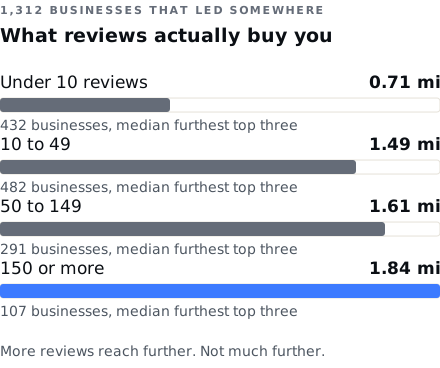
1,312 businesses that led somewhere, by review count.
| Reviews | Median furthest top three |
|---|---|
| Under 10 | 0.71 miles |
| 10 to 49 | 1.49 miles |
| 50 to 149 | 1.61 miles |
| 150 or more | 1.84 miles |
Going from a handful of reviews to over a hundred roughly doubles how far your top three placement travels. That is a real, earned, permanent gain and it is worth the effort of asking every finished customer.
It also takes you from 0.7 miles to 1.8 miles. It does not take you across a city, and no amount of reviews will. Both halves of that sentence are true and most people only ever get told one of them.
What this means if you are buying local SEO
- A single ranking check means nothing. Somebody standing in your unit searching your trade tells you what Google shows from that spot, and nothing about the rest of your area.
- Ask where you rank, not whether. The honest version of this work is a map before anything changes and the same map later, same grid, same words, same tool.
- Judge the promise against the geography. Covering a whole city is not a stretch target, it is not a thing that happens. Being reliably top three across the two or three miles where your customers actually are is.
- Reviews are the lever worth pulling, because they are permanent, they are yours, and they measurably extend your reach. Roughly a mile of it, and it is the same routine every month rather than a campaign.
- Where you are registered matters more than anything you can buy. That is uncomfortable and it is what the data says.
Method, and what it does not show
Forty geogrids: 4 trades across 10 UK towns, 49 points per grid in a 7 by 7 pattern, 2 miles apart, so each grid covers 12 miles by 12. Every point was a Google Maps search pinned to that coordinate, top 20 results kept with each business’s own latitude and longitude. Run 25 August 2026, total cost $3.92.
One filter matters and it is worth explaining, because getting it wrong would have wrecked the whole study.
15.5 per cent of the businesses in this data sit on a coordinate shared with at least one other business, and the clusters are city centres: 67 at Glasgow city centre, 67 at Manchester, 50 at Bristol, 42 at the geographic centre of the UK, and 137 more on a single coordinate near Salzburg that the data provider appears to use when it has no location at all.
That is what a service area business with a hidden address looks like in a dataset. The pin is not the address, it is the middle of the area. So the distance from that pin to a searcher is not a real distance and it cannot be used. 4,288 observations came out on that basis, plus 448 beyond 15 miles, leaving 24,924.
We originally read those coordinates as broken pins on real businesses and nearly published that. They are not broken, they are absent, which is a different thing and a much duller one.
Four limits worth stating.
- Top three in Maps is not identical to the map pack you see on a normal Google results page. It is the closest available proxy and the shape of the finding would not change.
- One day, one snapshot. Local results move, and this is where things stood on 25 August.
- Service area businesses are largely absent from this. They are the ones sitting on a city centroid, and taking them out was the only honest option once their distances turned out to be unmeasurable. So this measures businesses with a real address, and a study of service area firms would need a different method entirely.
- Four trades in ten towns. Different trades and rural areas will behave differently, and the thin-supply tail suggests rural especially so.
We will run the same 40 grids again in twelve months. The number we will be watching is not the decay curve, which we expect to be stable, but whether reviews buy more or less distance than they do today.