

SEO for tradesmen
SEO for tradesmen who are invisible three streets away.
Most are, and don't know it. You show up when you search your own name, so it feels fine. But the people who don't know you exist are searching your trade, and a few streets out you quietly disappear. This is about finding out exactly where, and fixing what can actually be fixed.
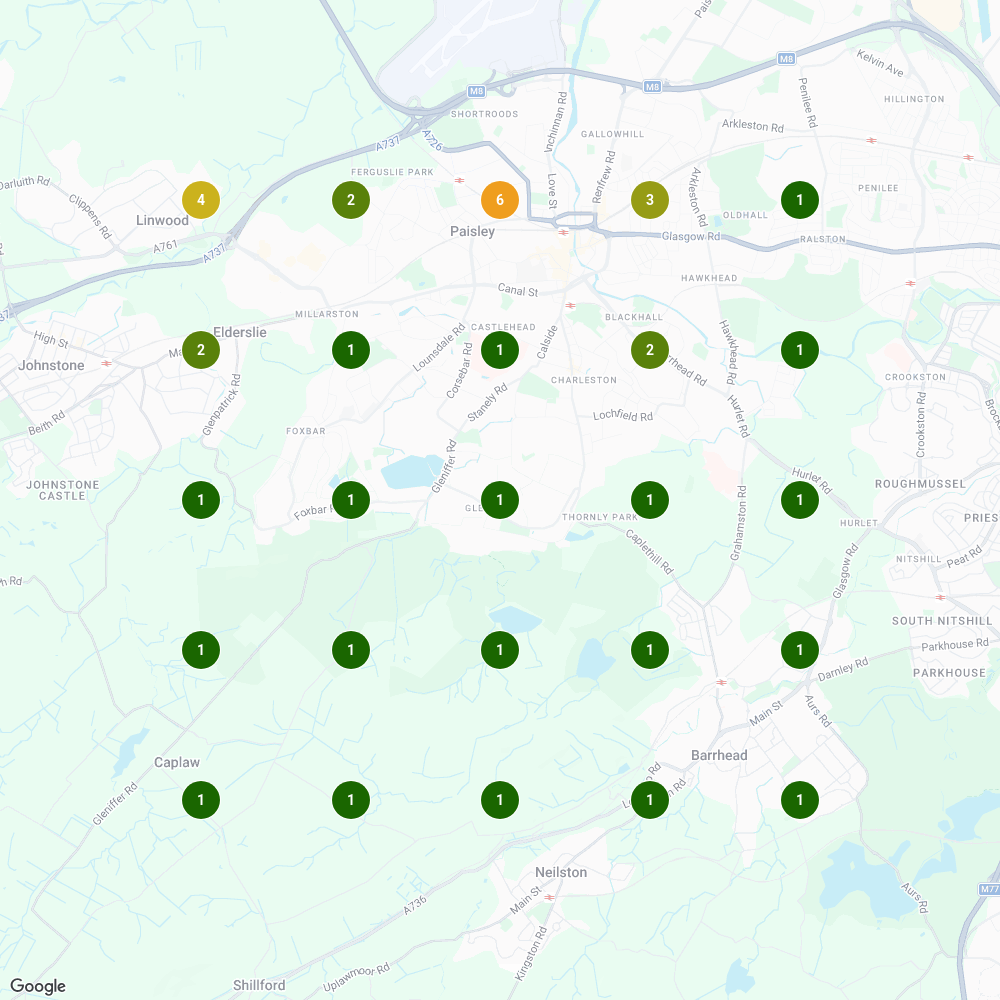
A real scan, not an illustration: a joinery business near Paisley, 12 August 2026. First almost everywhere, sixth in the town centre.
The problem
Your van covers twenty miles. Your listing covers about two.
Most trade businesses will happily drive half an hour for a job. Google doesn’t care. When somebody searches “roofer near me” or “emergency plumber”, more than half of what decides who gets shown is simply how far that person is standing from your door.
So there’s a gap between the area you’ll work and the area you actually appear in. Most tradesmen have never seen that gap measured. They just notice the phone is quieter than it should be and assume it’s the market.
A geogrid measures it. Forty-nine searches run from forty-nine points across your area, each one asking what a customer standing in that street would actually see. Put together, they show the shape of the problem instead of a guess about it.
How your customers search
They type “near me”, and the map answers.
Here is what people in the UK actually typed in July 2026, side by side with the town-name version of the same search. The difference is not close.
| What they type | Searches in July | The town version | Searches in July |
|---|---|---|---|
| plumber near me | 90,500 | plumber glasgow | 2,400 |
| electrician near me | 60,500 | electrician glasgow | 1,000 |
| roofer near me | 22,200 | roofer glasgow | 1,000 |
| joiner near me | 12,100 | joiner glasgow | 720 |
UK searches, July 2026, pulled from Google’s keyword data on 28 August 2026.
Depending on the trade, fifteen to sixty times more people search “near me” than name the town. And “near me” results are decided by where the searcher is standing, which is why the same search shows a different three businesses from one street to the next. Your customers are not searching a town. They are searching a spot on the map, and the work is making sure more of those spots show you.
What we measured
How far a map ranking actually reaches.
In August 2026 we ran the measurement ourselves rather than quoting somebody else’s blog: 1,959 real searches across ten UK towns, four trades, 24,924 usable rankings. Three findings matter to you.
First place reaches about 0.9 miles
The median business that took first place anywhere held it to just under a mile from its pin. Within a mile, roughly three in ten appearances were top three. By three miles out, close to one in ten.
Nobody owns a whole town
Of 1,312 businesses that held a top three spot somewhere, not one held it across most of its own area. A typical town had about three dozen different leaders depending on the street. That is why we will never promise you a town, and why you should walk away from anyone who does.
Reviews travel
Businesses with fewer than ten reviews held top three spots to a median of 0.71 miles out. Businesses past 150 reviews reached 1.84 miles, over twice as far. Reviews are one of the few levers you fully control, and this is what they are worth.
The full method and every number is published in the study itself, so you can check rather than trust.
What moves it
Four things, in the order they matter.
Where Google thinks you are
The pin. If it’s in the wrong place, you’re competing for the wrong streets and nothing else you do will fix it. This is a ten minute job and it is the single most common thing we find wrong.
What Google thinks you do
Your primary category is the most powerful field you control. A roofer listed as a “construction company” is fighting with one hand tied. Pick the category for the work you want, not the work you drifted into.
Whether your details agree with each other
Name, address and phone number, matching across your listing, your website, your van and the directories. When they disagree, Google trusts you less. It’s dull and it works.
Reviews, earned honestly
Reviews carry real weight, and in trades they carry extra because people are letting a stranger into their house. In our study the businesses past 150 reviews reached over twice as far as the ones under ten. A simple routine for asking beats buying fakes, which is the one thing that can end your listing entirely.
What it costs
Priced in the open, which turns out to be rare.
We checked 504 UK agencies in August 2026 and only 59 of them, about one in eight, publish any SEO price at all. Among the ones that do, the median entry price is £425 a month.That study is published too, numbers and method included.
Mine is on the pricing page: website and Google listing from £500 setup and £75 a month. The monthly fee buys the same rank map re-run on the same grid, next to Google’s own figures for how many people called you. If the numbers stop moving, you can see that too, and you can cancel any month.
Pick your trade
It works differently depending on the job.
An emergency call-out and a planned rewire are searched in completely different ways. These go into the detail for each.
Not on the list? It doesn’t matter. The work is the same for any business that gets its jobs from people nearby.
Questions
Worth asking.
Can you get me top three across the whole town?
No, and we can show you why rather than just claiming it. In August 2026 we measured 24,924 map rankings across ten towns, and not one business held a top three spot across most of its own area. A typical town had about three dozen different leaders depending on the street. What can be done is real but smaller: extend your reach street by street and win the part of the map nearest you properly. Anybody promising you the whole town is promising something the data says does not exist.
I already come up when I search my own name. Isn't that enough?
No, and it's the most common false comfort in this trade. Google served you that result standing where you were standing, and it knows who you are. The question is what somebody two miles away sees when they search for your trade and don't know you exist. That's usually a different answer, and nothing tells you.
Do I need a website, or just the Google listing?
Often just the listing, at least to start. For a lot of trades the fastest wins are in the Google Business Profile: the pin in the right place, the right main category, your name and number matching everywhere. If your existing site loads fast and says how to call you, keep it and spend the money on the listing.
How long before it does anything?
Some of it moves in days. Fixing a pin or a wrong category can make you eligible to appear almost immediately. Earning a strong position takes months. The sixty-day map is how you check whether it was worth it, rather than taking our word for it.
Are you only working with roofers, plumbers and electricians?
No. Those are the trades that search for this most, so they have their own pages. We work with any local business that gets its work from people nearby. If your trade isn't listed, it isn't a problem, just ring us.
I'm not near Paisley. Can you still help?
Possibly, and we'll be straight about the trade-off. We're in Paisley and we work across the west of Scotland in person, which means we can come and stand in your yard and see the job. Further afield the work is the same but it's done on a screen, and that suits some businesses and not others. Tell us where you are and we'll tell you honestly whether it's worth it.
Where you stand
Find out where you actually rank.
Send us your business name and the areas you cover, and we’ll check where you’re showing up across your area and where you’re not. There’s no charge for it, and if you’re already doing well we’ll tell you that.