

How this works
Why is my business not showing on Google Maps?
Most businesses not showing on Google Maps are hidden rather than beaten. Here is the test that tells you which one you are, and what actually fixes it.
Most of the time this is not a ranking problem. A business missing from Google Maps is usually hidden rather than beaten, and the difference decides everything you do next. Hidden is a setting, and somebody can change it this afternoon. Beaten is months of work.
So before you pay anybody to fix your rankings, find out which one you have got.
The check takes two minutes and it decides whether you have a settings problem or a ranking problem.
Are you hidden, or are you just not ranking?
Search your exact business name and your town, in a private window, on mobile data rather than the office wifi. If your profile comes up, you are visible and this is a ranking problem. If nothing comes up, you are hidden, and no amount of SEO will move a profile Google is not showing at all.
Log out first. Signed into the account that owns the listing, Google will happily show you a profile that nobody else in the country can see. That is the single most common reason a business owner believes their listing is fine when it is not.
If your business appears when you search its exact name and town, you are eligible and the problem is ranking. If it does not appear at all, you are hidden, and everything else is a waste of money until that is fixed.
The four things that hide a profile completely
A hidden profile is almost always one of four things. Three of them are fixable in an afternoon, and the fourth is fixable in a few weeks. None of them is SEO.
It was never verified, or verification lapsed
Google does not show a profile publicly until verification is finished, and a half-finished verification looks identical to a finished one from inside the dashboard. Postcard verification expires. Video verification gets rejected and the email goes to a spam folder nobody reads.
Check the profile for a prompt asking you to verify. If it is there, everything else on this page is irrelevant until it is gone. Google’s own page on finding your business on Google covers what the states mean.
It is suspended
A suspension hides the profile from everyone but you. The usual triggers on a trade business are extra words in the business name, an address the business does not control, or a burst of edits made all at once.
The name one catches people constantly. “Smith Electrical” is your name. “Smith Electrical, Emergency Electrician Glasgow, 24hr” is a keyword-stuffed name, and putting it there is the fastest way to lose a working listing. It also does not work as well as the person who suggested it told you it would.
There are two of them
Duplicate profiles cancel each other out. This happens when a business moves, when somebody creates a second listing rather than claiming the one Google already generated, or when an old listing under a previous trading name never got closed.
Google filters duplicates, and it does not always keep the one you have been working on.
The address does not match the kind of business you are
If crews go to customers rather than customers coming to you, you are a service area business and the address should be hidden. If you have a shop, a yard or a unit that customers actually visit, the address should be showing. Getting this the wrong way round is a common cause of a profile that either vanishes or shows up in the wrong place entirely.
The pin matters as much as the address. A pin dropped a few miles from where the business actually operates does not make you rank badly across your area. It makes you ineligible for it, which is a different and worse problem.
How long should a new profile take to appear?
A new profile normally shows within a few days of verification finishing, and up to a couple of weeks is still normal. Past a month with verification complete and no suspension notice, something is wrong and waiting longer will not fix it.
The trap in that first fortnight is impatience. Somebody creates a second listing because the first one has not appeared yet, and now there are two, which is the duplicate problem from a standing start. If the profile is verified and quiet, leave it alone and check again in a week.
If it is suspended, what actually happens next
You appeal, and you do it once, properly. Google’s appeals process asks for evidence that the business is what it says it is at the address it claims: a utility bill, insurance paperwork, photographs of the van and the signage, the business registration.
Two things to get right. Fix whatever caused it before you appeal, because appealing an unchanged profile just gets refused again. And do not create a new listing to get around a suspension. That turns a recoverable problem into two suspended profiles and a harder conversation.
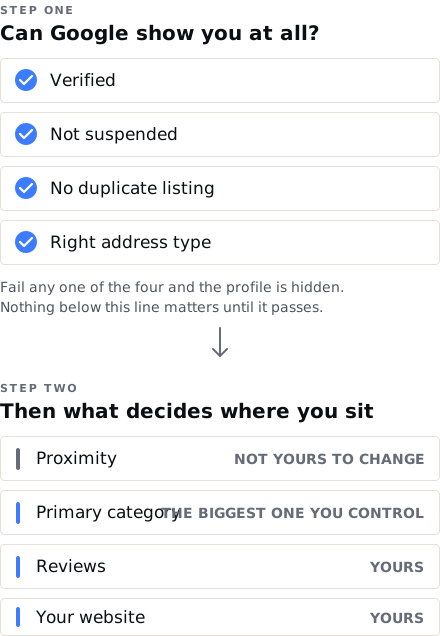
Eligibility comes first. Nothing in step two matters while anything in step one is failing, and only three of the four things in step two are yours to change.
It shows for my name, so why can nobody find me?
If the profile appears for your business name but not for the work you do, you are eligible and you are being outranked. Two things account for most of that: the primary category you are filed under, and how far the searcher is standing from you.
The primary category
The primary category is the single most influential thing you control on a Google Business Profile. It is Google’s answer to what your business actually is, and being filed as something vaguer than what you do costs you before anything else starts.
An electrician filed as “Contractor” is competing in a category most of their customers are not searching. Changed to “Electrician”, the same profile becomes eligible for searches it was invisible for. Same business, same reviews, same address, different bucket.
Proximity, which nobody controls
The rest of it is mostly distance, and distance is not for sale. According to the Whitespark Local Search Ranking Factors survey for 2026, proximity is about 55 per cent of what decides the map pack.
| Factor | Weight | Can you change it |
|---|---|---|
| Proximity to searcher | About 55 per cent | No |
| Profile signals | About 32 per cent | Partly |
| Reviews | About 16 to 20 per cent | Yes |
Read that table honestly and it says the biggest single factor in local search is where the customer happens to be standing. That is why you can sit top of the map in one part of town and be nowhere three miles away, on the same search, on the same day.
You do not have a ranking on Google Maps. You have a map. It changes street by street, and the shape of it is almost never the shape the owner expects.
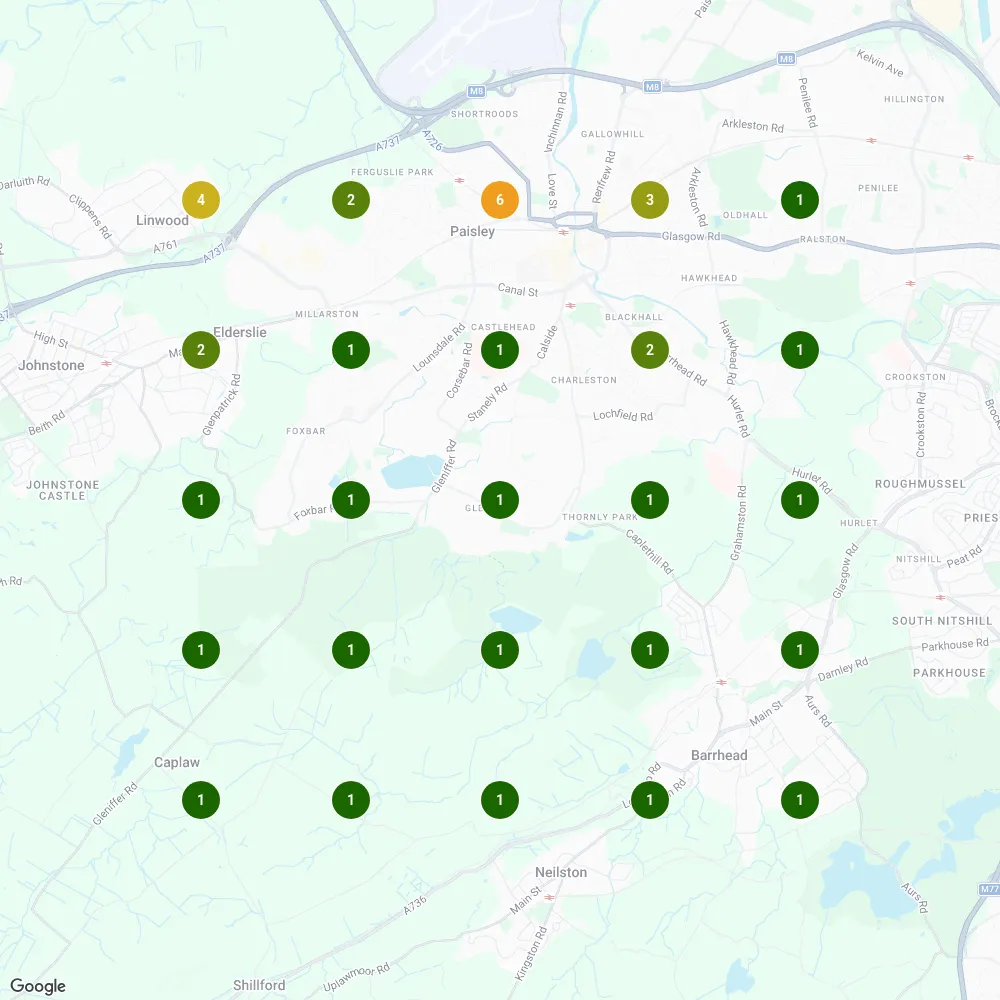
A real scan for a joinery business near Paisley, run on 12 August 2026. Note where it is weakest: sixth in the town centre and first almost everywhere else, which is the opposite of what most people expect.
Reviews, and the bit of it you can actually move
Reviews are worth about 16 to 20 per cent of the same weighting, and unlike proximity they are yours to change. There is no clever shortcut here and the ones being sold are the sort of thing that gets a profile suspended. A routine for asking every finished customer beats anything else on offer.
Where does my website come into this?
Your website does not put you on the map, and the map does not fill in your website. They feed each other. Google reads the site to work out whether the profile is telling the truth, so a site that names the same business, the same address and the same phone number as the profile is a signal, and one that contradicts it is a problem.
The other half is what happens after somebody finds you. A map listing that sends people to a site with no phone number on it, or one that takes eight seconds to load on 4G in a loft, has done its job and wasted it. That is a website problem rather than a listing problem, and it is usually the cheaper of the two to fix.
What we would check, in this order
Work down the list. There is no point looking at the bottom of it while something at the top is broken.
- Search your name, logged out. Private window, mobile data. This one test tells you whether you have a visibility problem or a ranking problem, and it costs two minutes.
- Look for a verification prompt. An unverified profile is invisible to everybody except the person who owns it.
- Read your business name exactly as it appears. If there are extra words in it that a sign writer would not put on a van, take them out.
- Search for duplicates. Your name, your old name, your phone number, your address.
- Check the address type. Hidden if crews travel to customers, showing if customers come to you.
- Check the pin. Drag it back to where the business really is.
- Then look at the primary category. Not before. It cannot help while the profile is hidden.
The part nobody can fix
No one can move you to the top of the map across a whole town, and anybody who says otherwise is selling something. Proximity decides too much of it, and proximity is measured from your address, or from the hidden address behind a service area profile.
What can be changed is whether you are eligible at all, which category you compete in, how many reviews you have and how good your website is at turning a click into a phone call. That is a real piece of work with a real ceiling, and the ceiling is worth knowing about before you spend anything.
If you want the honest version of where you stand, the useful thing is not a ranking report. It is the same search run from thirty or forty points across the area you actually work in, so you can see the shape of it. That is what we do first with anybody, and it is how local search gets measured properly rather than guessed at.