

How this works
How to reply to Google reviews as a trade business
How to reply to Google reviews, the good ones and the bad ones, in a way that keeps the customer, keeps the profile safe and does not start a public argument.
Reply to every review within a day or two. Thank the customer by first name, say in a few words what the job was, and stop. For a bad one, reply once, calmly, offer a phone number and take it off the page. Never argue in public, and only report a review to Google if it breaks a policy, because disagreeing with it is not one.
That is the whole method. The rest of this page is why, the mechanics, and what to write.

Two minutes at the end of the day, in the van, is all a reply needs.
Does replying to Google reviews help you rank?
Not directly, as far as anyone can show. Google does not say a reply moves a ranking and I have not seen evidence that it does. What reviews themselves do is well established: the Whitespark Local Search Ranking Factors survey for 2026 puts reviews at about 16 to 20 per cent of what decides the map pack, one of the few parts you control.
A reply does a different job. The next customer reads the reviews before they ring. They read your replies too, and a business that answers a complaint like a grown up looks safer to hire than one that answers nothing, or answers with a paragraph of excuses.
The review is for you. The reply is for the next person reading it.
How to reply, the mechanics
Google’s own steps are short. Open your Business Profile, select Read reviews, select Reply next to the review, type it, select Reply again. That is it, on a phone or a computer. Google’s page on managing customer reviews has the same steps with pictures.
Four things about a reply that people do not expect:
- It is public. It appears under the customer’s review with your business name on it. Your personal name is not shown.
- The customer is told. Google notifies the person who wrote the review when you reply.
- Google checks it first. Replies are reviewed against the content policies. Google says that usually takes up to ten minutes, and sometimes up to thirty days.
- You can change it. Under your reply there is Edit and Delete. A reply written in anger can be taken back the next morning, though the customer may already have seen it.
What to write for a good review
Short, specific, and in your own voice. Three lines is plenty.
- Use their first name. It shows a person read it rather than a template.
- Name the job. “The bathroom in Elderslie” tells the next reader what you do and where.
- Say thanks, then stop. No sales pitch, no “call us for all your plumbing needs”.
Something like: “Thanks, Anne. Glad the new consumer unit is all sorted, and thanks for keeping the dog in while I was up the loft. See you for the outside socket in the spring.” That reply is more useful to the next customer than any line on your website, because it is obviously real.
What to write for a bad review
The rules matter more here than the words. Get these right and almost any wording works.
- Reply once. One reply. If they reply again, you do not.
- Do it calmly, the next day if you need to. A day’s delay costs nothing. A reply written at eleven at night can cost the account.
- Give them a route off the page. A phone number and a name. The argument, if there is one, happens on the phone.
- Say nothing about money owed. An unpaid invoice is real, and it is still the worst thing to put in a public reply. It reads as a threat to everyone else.
- No personal details. Not their address, not what was wrong with their house, not who they live with.
Something like: “Sorry this went badly, Mr Reid. That is not the standard I want and I would rather put it right than argue about it here. Call me on the number on the profile and we will sort it out.” Four sentences. Anyone reading that thinks you are safe to hire, whatever the review said.
A calm reply to a bad review does more for you than ten good ones with no reply at all.
The review that is not really yours
Some reviews are not honest experiences. A competitor. Somebody you never worked for. An ex-employee with a grievance. A review meant for a different firm with a similar name. These are the ones to report, and reporting is a separate thing from replying.
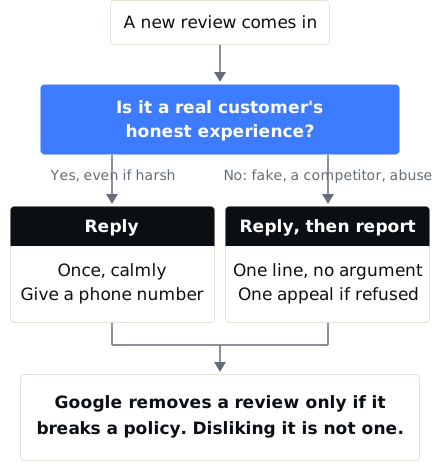
The decision is about what the review is, not how it made you feel.
Google’s content policy for Maps lists what gets removed: content not based on a real experience, reviews with a conflict of interest such as current or former employees, off-topic content, and harassment. It also says plainly that it allows content that describes negative experiences in a respectful manner. So an honest one star review stays, however unfair it feels.
To report one: Read reviews, Report next to the review, pick the reason, send. Google’s page on flagging reviews says evaluation typically takes several days, and that if it is refused you get one appeal. It also says not to report a review just because you disagree with it or dislike it.
Reply to it as well, in one line, so the next reader sees you noticed: “I have no record of this job and I have asked Google to look at it.” Then leave it.
What never goes in a reply
- An offer. A discount to change or remove a review is what Google calls fake engagement, and it is prohibited. It puts the whole profile at risk to fix one review.
- The word fake, unless you are reporting it. Calling a real customer a liar in public is a loss even when you are right.
- The invoice. See above.
- Anything you would not say on their doorstep with the neighbours listening, because that is exactly who is listening.
| Review | Reply | Then |
|---|---|---|
| Good | Three lines, their name, the job | Nothing |
| Bad but honest | Once, calm, phone number | The phone call |
| Not a real customer | One line | Report, appeal once |
What the reviews are worth
Replying is the cheap end of a routine. The expensive end, in effort rather than money, is asking every finished customer, and that is where the ranking comes from.
When I measured 40 UK towns from 49 points each, the businesses that led the map somewhere with under 10 reviews held a top three placement out to a median 0.71 miles. With 150 or more it was 1.84 miles. Reviews roughly doubled how far a business travelled. They did not take anyone across a city, because proximity is about 55 per cent of the decision and nobody controls it.
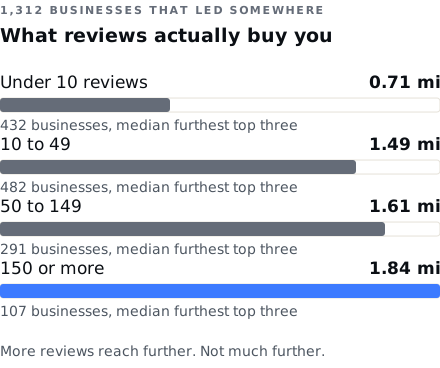
1,312 businesses that led a map somewhere, by review count, from 40 UK geogrids in August 2026.
That is the honest size of the prize. A reply routine keeps the reviews you have working for you. An asking routine gets you more of them, and the link that makes asking easy is free from Google. Where the two routines fit in the rest of the picture is on the SEO for tradesmen page.