

Original research
Google map pack ranking factors: four sales claims tested
Everyone selling local SEO claims to know the google map pack ranking factors. We ran four studies and over 2,200 searches to test what trades get told.
The map pack runs on three things: how close you are to the searcher, how strong your profile is, and how much Google trusts what it can read about you. Roughly in that order, and the biggest one is the one nobody can sell you.
This August we ran four studies to put numbers on that: 40 geogrids measuring 24,924 ranking observations, a crawl of 445 trade websites Google already ranks, 80 ChatGPT recommendation prompts, and a sweep of 504 UK agency websites. Every figure below comes from one of them, each study is linked with its method, and the total data bill for all four was under $12.

Four studies, one day, 25 August 2026. Every claim below is tested against them.
Here are four claims a trade business owner will hear on a sales call, tested against that data.
Claim one: “We will get you to number one in your town”
Nobody is number one in a town, because a town does not have one result. It has a different result on every street.
In the geogrid study we searched 40 UK towns from 49 points each, 4 trades, 2 miles between points. A median of 36.5 different businesses came first somewhere inside each 12 mile square. The tightest grid had 22 different leaders, the loosest 47. In none of the 40 grids did a single firm lead throughout, and the best coverage any business managed was 6 points out of 49.
| What the claim implies | What 40 grids showed |
|---|---|
| One firm can lead a town | 0 of 40 grids had one leader |
| Rankings are one number | Median 36.5 leaders per town |
| Top spot is winnable everywhere | Best coverage seen: 6 of 49 points |
A pin’s reach fades street by street, and other pins are already standing where it runs out.
So when somebody promises the top spot, the useful question is which street corner they mean.
Claim two: “We know the ranking factors and we control them”
The largest single factor is proximity. The Whitespark Local Search Ranking Factors survey for 2026 puts it at roughly 55 per cent of what decides the map pack, and our measurements show what that looks like on the ground: a business under a mile from the searcher was in the top three 29.5 per cent of the time. Between 5 and 8 miles, 10.1 per cent.
| Distance to the searcher | In the top three |
|---|---|
| Under 1 mile | 29.5% |
| 1 to 2 miles | 16.6% |
| 2 to 3 miles | 12.9% |
| 5 to 8 miles | 10.1% |
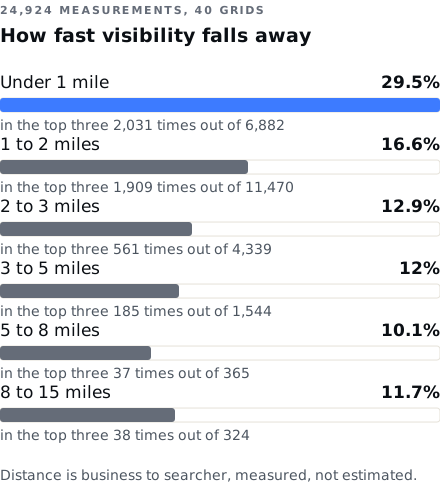
24,924 measurements across 40 grids.
Visibility roughly halves in the first mile, and no agency moves your unit closer to the searcher. An honest version of this work optimises the factors that do move, and says out loud that the biggest one is fixed.
Claim three: “Reviews will get you seen across the city”
Reviews are the strongest lever you actually hold, and they still only buy about a mile.
Among the 1,312 businesses that led the map somewhere, those with under 10 reviews reached a median 0.71 miles with a top three placement. Those with 150 or more reached 1.84 miles. That is 2.6 times the reach, it is real, it is permanent, and it is yours rather than rented. It is also not a city. Both halves of that sentence are true, and a sales pitch usually contains only one of them.
Claim four: “AI is the new search, we will get ChatGPT recommending you”
We asked ChatGPT for a trade recommendation 80 times across 8 trades and 10 towns. Every single answer cited a directory. Of 405 cited sources, 71.9 per cent were directories and 13.8 per cent were a business’s own website. Checkatrade was cited 78 times out of 80 answers, MyBuilder 70 times.
In smaller towns like Paisley, Johnstone and Renfrew it is starker: own websites appeared in 31.3 per cent of answers, against 52.1 per cent in the big cities. Whatever an agency promises about AI visibility for a small trade business, today the machine mostly recommends directories. There are things worth doing about that, but a promise of ChatGPT recommendations is ahead of the evidence.
What actually moves, on the numbers
The same studies point at three things a trade business in Glasgow or Renfrewshire can do that the data supports.
- Fix what Google reads first. Of 445 trade websites already ranking in local packs, 16.9 per cent had no phone number in their readable text and only 29.7 per cent carried LocalBusiness schema. Those are solved in an afternoon and most competitors have not solved them.
- Run the review routine. Asking every finished customer is the whole method, and the payoff is measured above in miles. It compounds and it cannot be switched off by an unpaid invoice.
- Measure with the same yardstick before and after. A geogrid scan costs about 40p. Anybody doing this work should show you the same grid, same keywords, before and after, because a single search from one spot tells you almost nothing.
Method
Four studies, all run on 25 August 2026, all with their scripts and findings kept so they can be rerun. The geogrid study: 40 grids, 10 towns, 4 trades, 49 points each, 24,924 usable measurements, $3.92. The crawler study: 200 searches, 587 local pack businesses, 445 reachable websites, $0.79. The AI study: 80 prompts to GPT-4o with web search, $6.79. The pricing sweep: 504 reachable agency sites from 40 searches, used here for context on what this market will and will not say in public.
Each linked article carries its own limits. The short version: one snapshot in time, four trades, and service area businesses with hidden addresses are underrepresented in the geogrid data because their pins are not real locations.
If you want to know where you actually stand before anybody sells you anything, start with what a real scan of your own patch shows.