

Original research
AI visibility: what ChatGPT recommends for local trades
AI visibility for a trade business is not what you would expect. We asked ChatGPT to recommend a tradesperson 80 times and counted every source it cited.
On 25 August 2026 we asked ChatGPT to recommend a tradesperson 80 times, across eight trades and ten UK towns, and kept every source it cited. It cited 405 of them.
Every single answer, all 80, cited at least one trade directory. Two came back to a business because of that business’s own website.
If you have been told that a good website is how you get found by AI, this is the number that matters: of 237 businesses currently sitting in Google’s map pack for these searches, ChatGPT named 46, and only two of those were named off the back of their own site.
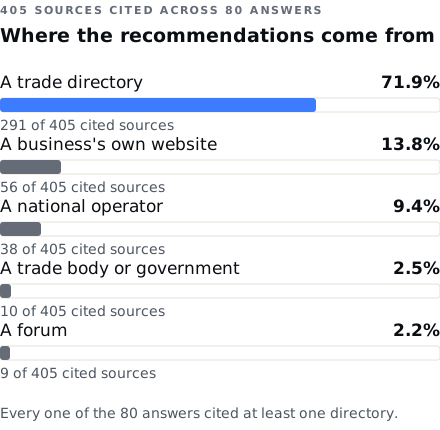
405 sources cited across 80 answers, 25 August 2026.
What we asked, and how
Eight trades, electrician through to painter and decorator, across six cities and four smaller towns: Glasgow, Edinburgh, Manchester, Leeds, Bristol and Birmingham, then Paisley, Barrhead, Johnstone and Renfrew. The smaller towns are in deliberately, because that is where a business is most likely to be invisible to a model.
One wording throughout, so the answers are comparable: “We need to hire a [trade] in [town]. Who would you recommend?” The model was GPT-4o with web search enabled, set to the UK.
Then we put the same eight trades and ten towns to Google and captured the map pack, so the two answers could be laid side by side.
Every answer came from a directory
Checkatrade was cited 78 times out of 80 answers, in all ten towns. MyBuilder was cited 70 times, also in all ten. Then Three Best Rated, Yell, TrustATrader, MyJobQuote and Which? Trusted Traders.
Of the 405 sources cited in total, 71.9 per cent were trade directories. A business’s own website accounted for 13.8 per cent, and a further 9.4 per cent were national operators, by which we mean domains cited across five or more different towns. We did not decide which of those were national by hand. A genuinely local firm gets cited in one town, so anything appearing in five or more is national whatever it calls itself.
Asked to recommend a local tradesperson, the model does not go looking for local tradespeople. It goes looking for lists of them, and then reads the list out.
What it does with the businesses Google ranks
This is where it gets uncomfortable for anyone who has spent money on local search.
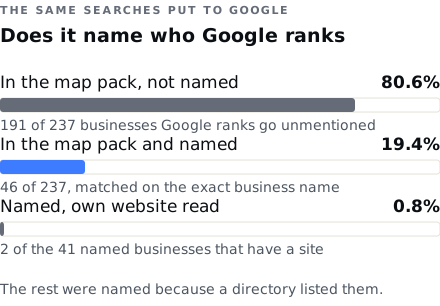
Matched on exact business name across 79 searches with a map pack.
| Of the businesses Google ranks | Count | Share |
|---|---|---|
| Not mentioned at all | 191 | 80.6% |
| Named by ChatGPT | 46 | 19.4% |
| Named, own website cited | 2 | 0.8% |
Four in five businesses that Google thinks are the best answer in their town do not appear in the AI answer at all. Fewer than half the answers, 34 of 79, named a single map pack business.
And of the 41 named businesses that have a website listed on their Google profile, two had that website read. The other 39 were named because Checkatrade, Three Best Rated or a similar list had them, and the model was reading the list.
Which means the map pack and the model are two different games
Ranking in the map pack is about proximity, your Google Business Profile and your reviews. Being named in an AI answer, on this evidence, is about being on somebody’s list.
They overlap, but not much, and they are won differently. That is worth knowing before anybody sells you a package that claims one buys the other.
The smaller the town, the worse it gets
In the six cities, 52.1 per cent of answers cited at least one business’s own website. Across Paisley, Barrhead, Johnstone and Renfrew, that fell to 31.3 per cent.
The directory share did not move at all. It was 100 per cent of answers in both. What changes in a smaller town is that there is less of anything else, so the list is more of the answer.
That is 48 answers against 32, so treat the gap as a direction rather than a measurement. It is the thing we would most want to test with a bigger sample.
If you are a trade business, what actually follows
We would not go and buy a Checkatrade subscription off the back of this. That is a separate sum and we have written up the arithmetic for it elsewhere. What follows is narrower than that.
- Being in the map pack is still worth having. It is where people who search on Google land today, and that is still most of them. This study does not say otherwise.
- Your listing on the big directories is doing a job you may not have counted. Even if the leads are poor, the listing is what a model reads. Whether that is worth the subscription on its own is doubtful, but a free or cheap listing being accurate and complete costs you nothing.
- The reviews on those listings are being read out loud. Nearly every business the model named came with a rating and a review count attached, lifted straight from the list.
- Your own website is not currently the route in, on this evidence. It is still the thing that converts the click when it comes, which is a different job that still has to be done properly.
- Nobody can sell you a guaranteed place in an AI answer. If somebody offers you one, this is the data to hold them to.
Method, and what this does not show
The full method: 80 prompts, one wording, GPT-4o with web search, UK, on 25 August 2026, every answer and every cited URL kept. Domains were classified as directories from a fixed list, and as national operators by appearing across five or more towns. A map pack business counted as named only when its exact name appeared in the answer text.
That last rule matters and it is deliberately strict. Our first pass counted a business as named if any distinctive word from its name appeared, which reported 95 per cent overlap and was nonsense. It was matching businesses called things like “Glasgow Plumbing Solutions” on the word Glasgow, and others on words like heating, garden and domestic. Exact names only took it from 95 per cent to 19.4 per cent. If anything the real figure is a little higher than 19.4, because a business that gets described rather than named will be missed.
Three limits worth stating.
- This is the API, not the app. GPT-4o with web search is not identical to what you get typing into chatgpt.com, and it is not Gemini, Perplexity or Copilot, which will each behave differently.
- It is one day. These systems change weekly and this is a snapshot, which is why the method is written down rather than summarised.
- One prompt wording. Asking “who is the cheapest” or “who is available today” would very likely produce a different mix, and that is the next version of this study.
We intend to run it again with the same eight trades and ten towns. The number to watch is not the directory share. It is whether that figure of two out of 41 ever starts moving.