

How this works
How much is Checkatrade per month, and does the maths work?
Asking how much is Checkatrade per month gets no straight answer, because it depends on your trade and your area. Here is the sum that tells you if it pays.
There is no single price, and anybody quoting you one off the internet is guessing. Checkatrade prices by trade and by area, so a roofer in a busy city pays a different number from a landscaper in a quiet one.
That makes the price the wrong question. The right one is how many jobs a month it has to win before it has paid for itself, and you can work that out in about five minutes with numbers you already know.

The sum takes five minutes and it uses numbers you already have.
Why nobody will give you a straight price
Checkatrade does not publish one figure, and on their own page about membership they say the cost depends on your trade, your location, the competition in your area and the level of leads. That is a real answer rather than an evasion. A directory sells attention, and attention in a busy postcode costs more than attention in a quiet one.
So when you ring them, you get a number for you. Two things to establish before you get to it: what the contract length is, and what happens to the price when it renews.
Any monthly figure you find in a forum or a blog is somebody else’s trade in somebody else’s town, quoted in some other year. Use it as a range to sanity check the quote you are given, never as the price.
The only sum that matters
Take the monthly fee you have actually been quoted. Take what you keep on a typical job after materials and your own time, not what you invoice. Divide the first by the second. That is how many jobs a month the subscription has to win before it starts making you money.
Here is the shape of it. These are made up round numbers to show the method, not Checkatrade’s prices and not anybody’s real figures.
| Monthly fee | Kept per job | Jobs needed to break even |
|---|---|---|
| £150 | £100 | 1.5 a month |
| £150 | £400 | Under 1 a month |
| £300 | £100 | 3 a month |
| £300 | £400 | Under 1 a month |
Read the right hand column and the decision usually makes itself. If you fit bathrooms and keep four figures on a job, one win a quarter covers a lot. If you do call-outs and keep £80 after your time, you need a steady stream of them and you should be asking hard questions about lead volume before you sign anything.
Then take one number off the answer, because not every lead becomes a job. If you quote five and win two, the subscription has to produce two and a half times as many enquiries as the break-even number. That is the sum most people skip and it is the one that decides it.
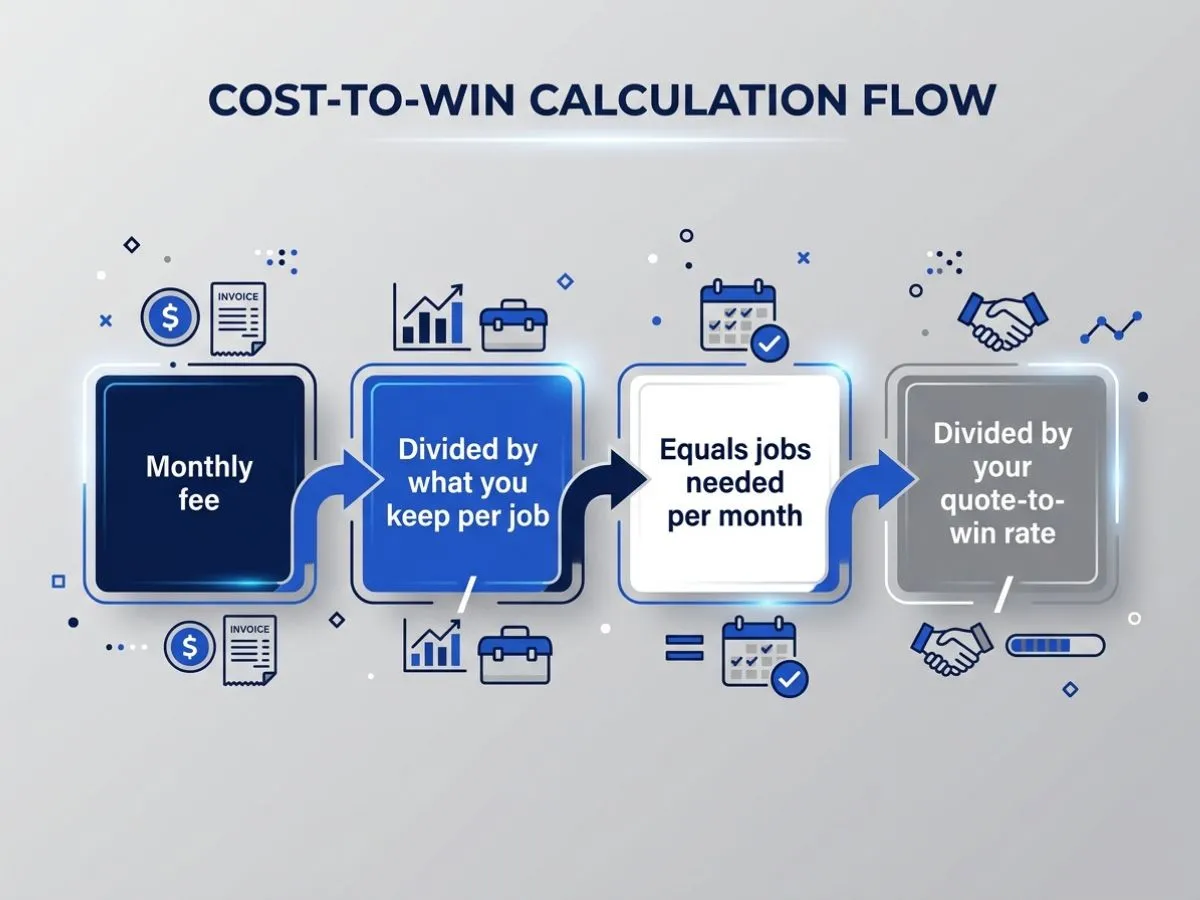
Fee divided by what you keep, then adjusted for how many quotes you actually win. That last step is the one people skip.
What the money actually buys
A subscription buys you a position in somebody else’s shop window, and it buys it by the month. That is not a criticism, it is just what it is, and it has two consequences worth being clear about before you sign.
It works fastest when you have nothing else
A new business with no reviews, no website and a profile Google has never heard of has a real problem: nobody has any reason to trust it yet. A directory rents you that trust immediately. For somebody in their first year that can be the difference between a diary with work in it and a diary without, and it is why plenty of good trades start there.
It stops the day you stop paying
The profile and the reviews on it belong to the platform. Stop the subscription and they go with it, and the years of good feedback you built up do not follow you anywhere. This is the part that catches people out at renewal, because by then leaving costs more than the money.
Rented visibility disappears the month you stop paying for it. Owned visibility does not. Both are legitimate, but only one of them is still there in three years.
What owning it looks like instead
The alternative is not free and it is not instant. A Google Business Profile, reviews on it and a website that answers the phone are yours, they carry over if you change your trading name, and nobody can switch them off because an invoice went unpaid.
The honest limits, because they matter more than the pitch:
- It takes months, not days. A profile that has just been set up does not compete with one that has been collecting reviews for three years. There is no way to buy that time back.
- Proximity decides a lot of it. According to the Whitespark Local Search Ranking Factors survey for 2026, being close to the searcher is about 55 per cent of what decides the map pack, and nobody controls that. You will never show up across a whole city.
- Reviews are the part you can move. They are worth about 16 to 20 per cent of the same weighting, and asking every finished customer is the whole method.
- The website has to do its job. A listing that sends people to a site with no phone number on it has wasted the click, which is a website problem rather than a listing problem.
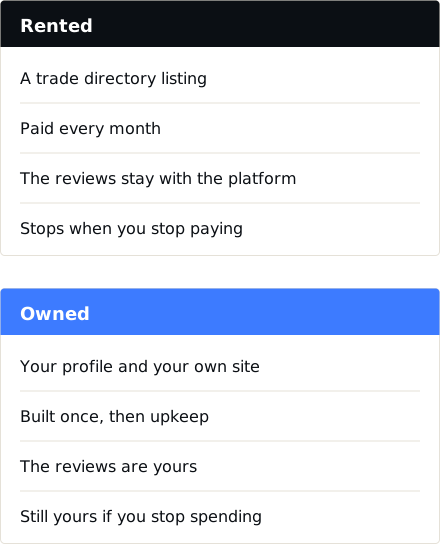
Both are real options. The difference is what you still have in three years.
Ask these five things before you sign
Get the answers on email rather than on a call, because a quote you can read again is worth more than one you half remember.
- How long is the contract, and can it be stopped inside the term or only at renewal.
- What does it renew at. A first year rate that steps up is common and it should be in writing.
- How many other trades in my category are on it in my postcode, and does the subscription give me any exclusivity at all.
- Are leads shared. If four of you get the same enquiry, your real cost per won job is four times what the arithmetic above suggests.
- What happens to my reviews if I leave. You already know the answer. Ask anyway and get it in writing, because it changes how much the years ahead are worth to you.
So is it worth it?
Sometimes, and it depends on where you are starting from. If you are new, unknown and need work in the diary this month, renting somebody else’s trust is a reasonable thing to buy while you build your own. If you have been going five years, have a listing that already shows up and reviews with your name on them, the same money spent on the things you keep tends to compound instead of evaporating.
What we would not do is treat it as a substitute for having your own listing sorted. The two do different jobs, and the directory is the one that stops the day you stop paying.
If you want to know where you actually stand before you spend anything, the useful starting point is not a quote. It is seeing where you show up and where you do not across the area you work in, because that tells you whether you are buying leads to plug a gap or buying leads you could have had anyway.