

Original research
How much does SEO cost in the UK? 2026 study, 504 agencies
Everyone answers how much does SEO cost in the UK with a guess. We checked 504 agency websites. Four in five will not say, and here is what the rest charge.
The honest answer is that most UK agencies will not tell you. On 25 August 2026 we checked the websites of 504 UK SEO and web design agencies, and 99 of them published a price. The other 405 want you to fill in a form first.
For the ones that do publish an SEO retainer, the median entry price is £425 a month, and the middle half sit between £299 and £750.
Every other answer to this question that we can find is somebody’s opinion. This one is a count.
The short version
- Sample: 504 UK SEO and web design agency websites, found across 20 UK cities, checked on 25 August 2026.
- Transparency: 19.6 per cent publish a price of any kind. Only 11.7 per cent publish one for SEO.
- Pricing pages: 115 agencies have one. On 58 of them there is no price.
- Median entry retainer: £425 a month, with the middle half between £299 and £750, from the 44 agencies that publish a monthly SEO figure.
- Range: £39 to £3,000 a month for the same nominal product.
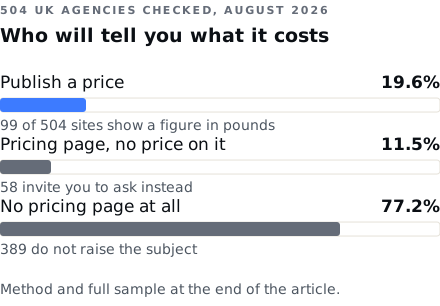
Counted on 25 August 2026. The method is at the bottom so you can repeat it.
How we built the sample
We took 20 UK cities, from London and Manchester down to Aberdeen, Norwich and Plymouth, and ran two searches for each: “seo agency [city]” and “web design agency [city]”. That is 40 searches, the top 20 organic results from each, and 769 results in total.
Stripping out the directories, the marketplaces, the social profiles, the software companies and a couple of city magazines left 524 real agency websites. Of those, 504 responded when we visited them. The population is deliberately “agencies a UK business would actually find”, because that is who you are choosing between.
For each one we checked the homepage, then followed any link that looked like pricing, then tried the usual paths if there was no such link. We obeyed robots.txt and identified the crawler.
Four in five will not tell you what they charge
Of 504 agency websites, 99 published a price of any kind, which is 19.6 per cent. Narrow it to a price for SEO specifically and it falls to 59, or 11.7 per cent.
So if you are ringing round for quotes, expect roughly nine in ten to make you ask.
Publishing a price is not the industry standard. It is the exception, and at fewer than one in five it is not a close call.
That surprised us less than the next bit.
A pricing page is not the same as a price
115 agencies had a pricing page. On 58 of them there was no price. Half of the pricing pages in the sample are a page called Pricing that explains why pricing cannot be explained, followed by a contact form.
The wording varies and the move does not. Every project is different. It depends on your goals. Get in touch for a bespoke quote. All of that can be true and it still leaves the person reading it exactly where they started, which is not knowing whether they can afford you.
The remaining 389 agencies, 77.2 per cent of the sample, have no pricing page at all.
What the ones who do publish actually charge
Forty-four agencies published a monthly SEO retainer with a number attached. Here is where those numbers land.
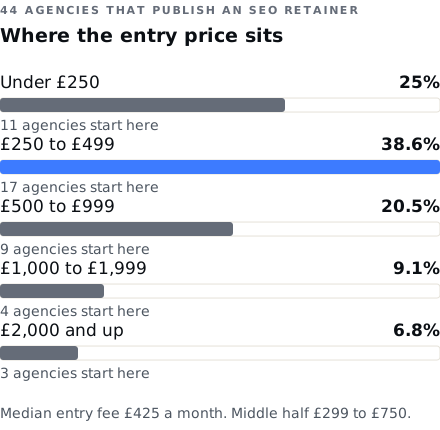
Entry level monthly SEO retainers, 44 agencies, August 2026.
| Entry retainer | Agencies | Share |
|---|---|---|
| Under £250 | 11 | 25% |
| £250 to £499 | 17 | 38.6% |
| £500 to £999 | 9 | 20.5% |
| £1,000 and up | 7 | 15.9% |
The median entry price is £425 a month and the middle half runs from £299 to £750. The cheapest retainer in the set was £39 a month and the highest starting price was £3,000 a month, which is a seventy-fold spread between two things both sold as monthly SEO.
Two things worth saying about that spread. It is entry pricing, so it is the cheapest thing each agency sells rather than what their average client pays. And a monthly figure on its own tells you nothing about how many hours sit behind it, which is the actual question.
The spread also hides what the money is for. A national ecommerce campaign and getting a trade business found across one town both show up in this data as a monthly number, and they are not remotely the same job.
The agencies that rank in the most places publish the least
This one is a weak signal and we are flagging it as weak. Thirty-three agencies in the sample ranked in more than one city. Three of those 33 publish a price, against 96 of the 471 that ranked in a single city.
That is 9 per cent against 20 per cent, but 33 is a small group and we would not build an argument on it. It is the kind of thing worth measuring again next year with a bigger sample before anyone calls it a pattern.
Why so few publish, and the case against them
There are real reasons, and it is worth putting them fairly.
- Scope genuinely varies. A site with 8 pages and a site with 800 are not the same job, and a single number can misprice both.
- Competitors read your website. Publishing your rate card tells everyone selling against you exactly where to aim.
- Anchoring cuts both ways. A number on a page can lose you a client who would have paid more, and win you one who was never going to be a fit.
The case against is simpler. Somebody with a budget of £300 a month who cannot find a single price on nine sites out of ten either books calls they will waste, or gives up. The form is not free for them. It costs an afternoon and the discomfort of being sold to before they know whether the number is even in range.
A price on a page does not commit you to it. It tells the wrong-fit buyer to leave and the right-fit buyer that they are in the right place, before either of you spends an hour finding out.
We publish ours, which is on the pricing page, and we would rather lose the enquiry on the number than on the ninth phone call.
If you are the one buying
- Get the figure in an email, not on a call. A quote you can read twice is worth more than one you half remember.
- Ask what the number buys in hours, not in deliverables. “Four hours a month” is checkable. “Ongoing optimisation” is not. How we scope and price the work is written down for the same reason.
- Ask what happens if you stop. Some of what you pay for is yours and stays. Some of it is rented and vanishes.
- Treat a refusal to quote a range as data. Not disqualifying, but the ones who can talk about money early tend to be easier to work with later.
- Compare like with like. £299 with no reporting and £750 with a monthly measurement are not the same product, and the cheaper one is not necessarily worse.
- Ask what they will measure. For anything local, the honest version is a map of where you actually show up across your area, taken before the work starts and again later on the same grid.
The method, so you can check it
The sample was built from Google organic results in the UK on 25 August 2026, using the two query templates above across 20 cities, top 20 results each. A site counted as publishing a price if a figure in pounds appeared within 120 characters of a pricing cue such as “from”, “per month”, “package” or “+VAT”.
The first version of this study said 111 agencies published a price. It was wrong, and the reason is worth publishing:
- Budget dropdowns. “What is your monthly organic search budget? £3,000 to £5,000” is the buyer’s money in a contact form, not the agency’s price.
- Market commentary. “Most SEO campaigns sit between £500 and £5,000 per month” is an opinion about the industry, quoted on an agency blog, not a price you can buy.
- Other people’s products. “Wix usually costs £10 to £50 per month” is not an agency rate.
Removing those three took the count from 111 to 99. We also put a floor of £25 a month on the price analysis, because below that the figures were hosting add-ons rather than retainers. We found the errors by pulling 40 sites back off the shelf and reading the sentence each figure came from, which is a step we would recommend to anyone publishing a number.
The study is a snapshot of one day. We intend to run it again in twelve months with the same searches, and the interesting number then will not be the median. It will be whether the share of agencies willing to say what they charge has moved at all.